One question, asked by two different regimes
PPWR (EU Regulation 2025/40) and US State EPR laws regulate packaging differently on paper, but underneath they ask the same thing: what is this packaging made of, how much of it is recycled material, is it reusable, and can you prove what actually happened to it after it shipped. Most of PPWR's substantive obligations are already binding law as of August 12, 2026 — the dates below are phase-in deadlines for specific thresholds, not a future start date for the regulation itself.
Answering that question well requires connecting data that, in most packaging software, lives in three disconnected places: a spec sheet that knows material and weight, a tracking system that knows what actually moved, and an ERP that knows what was sold. Tensor Dynamics was built as one platform spanning all three — PackMatrix for the packaging spec, FlowTrace for real asset movement and reuse, Axiom for order and production data. The sections below go through each requirement and show exactly which of those pieces answers it, and which ones we still have to build.
Mandatory Recycled Content
Plastic packaging placed on the market must contain a minimum percentage of recycled material, phased in across four categories against two milestone years:
| Category | 2030 | 2040 |
|---|---|---|
| Contact-sensitive PET | 30% | 50% |
| Other contact-sensitive plastic | 10% | 25% |
| Single-use beverage bottles | 30% | 65% |
| Other plastic packaging | 35% | 65% |
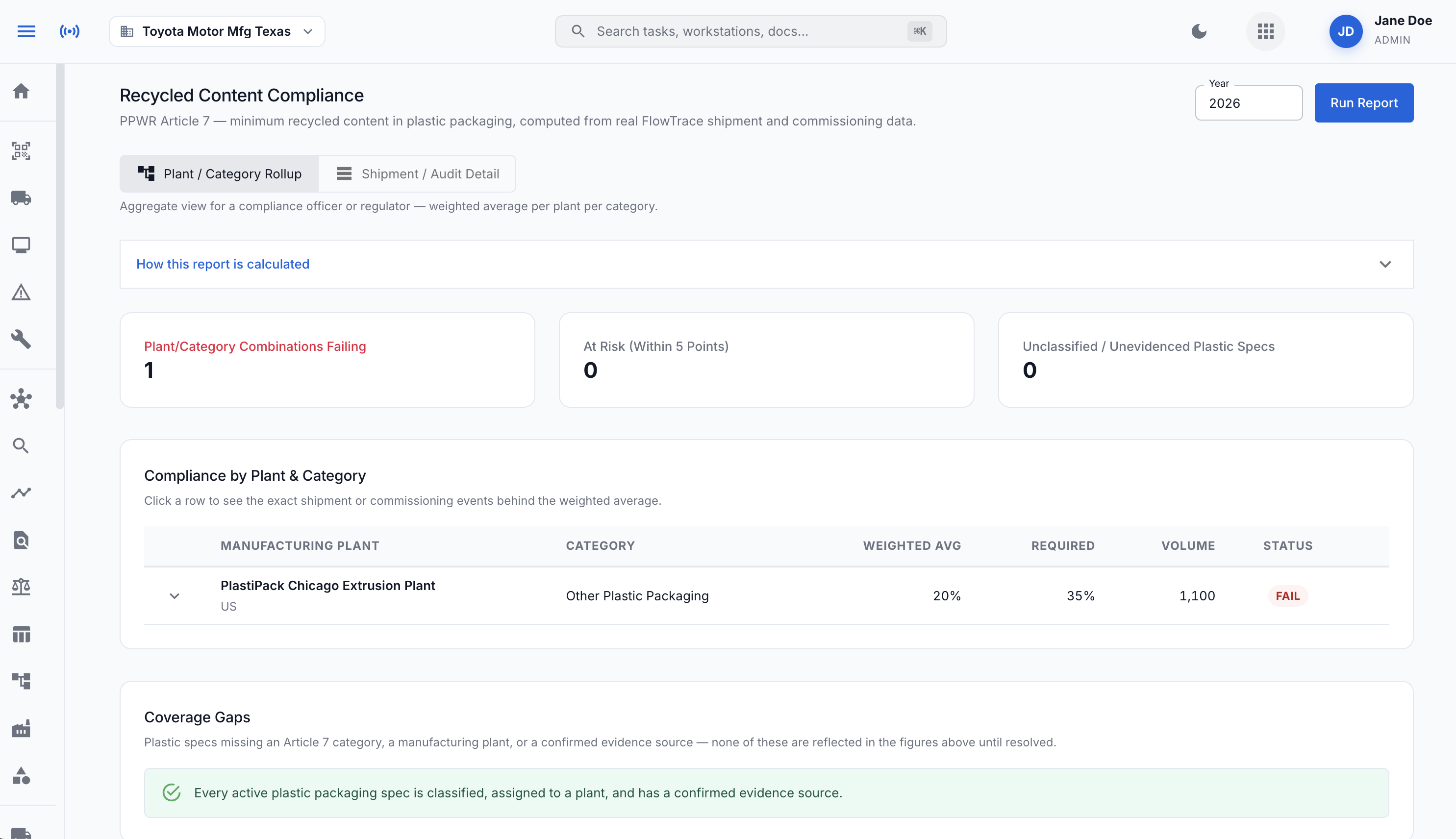
The critical detail most teams miss: this isn't measured per unit. It's a volume-weighted average, calculated per manufacturing plant, per category, per year. A container that's 20% recycled doesn't fail on its own — what matters is the weighted average across everything that plant produced in that category that year, against the matching threshold.
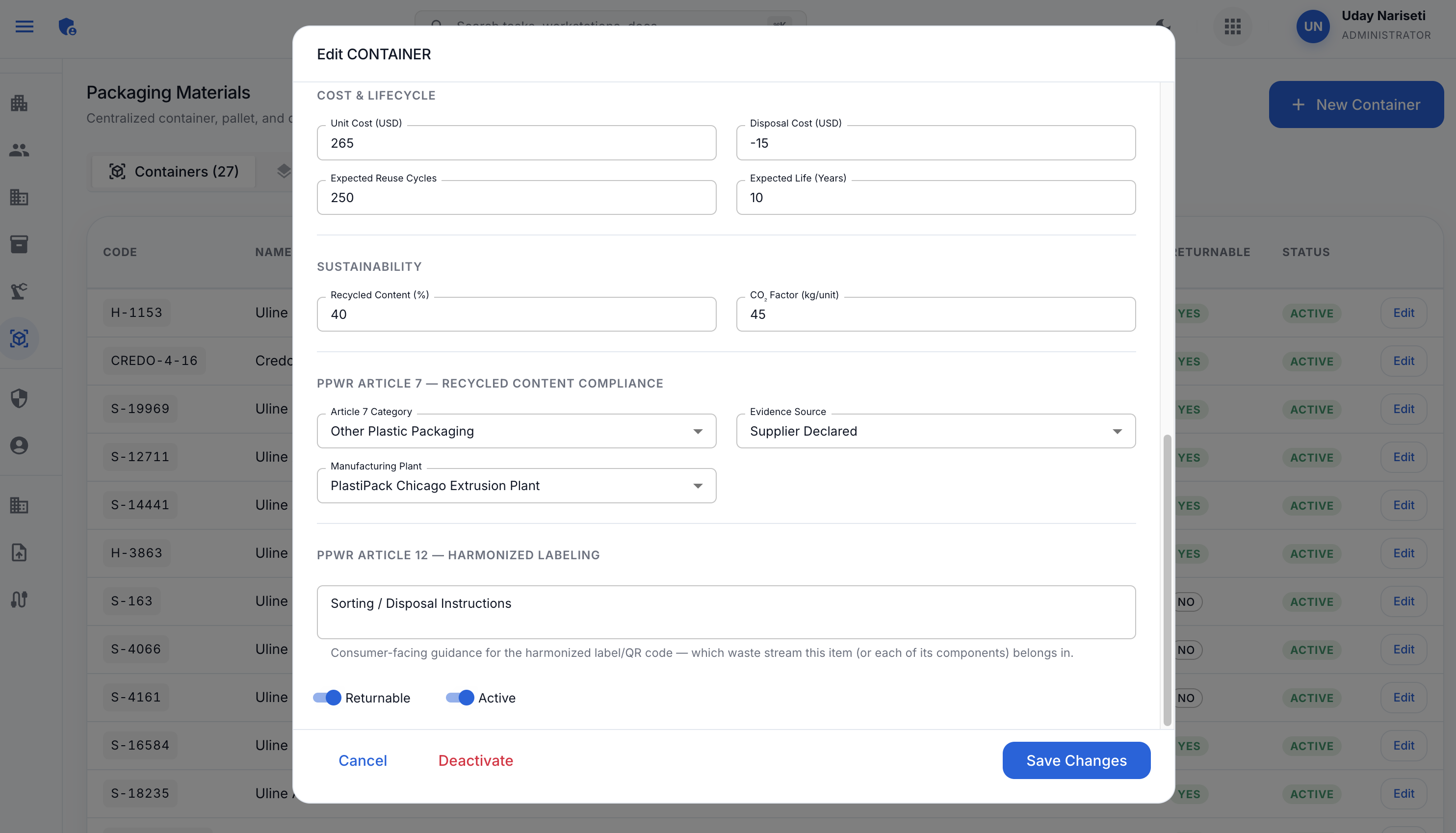
Every container and pallet spec in the packaging master carries its recycled-content percentage, its Article 7 category, an evidence source (supplier-declared, lab-tested, or third-party audited), and the manufacturing plant that produced it.
The volume side is where this gets real: for expendable packaging, volume comes from actual pack/ship events recorded in FlowTrace — not an order-line estimate. For returnable packaging, volume comes from newly commissioned units that year, not trip counts, because a reusable tote that ships 200 times was only placed on the market once. The report computes the weighted average per plant per category per year against the real thresholds, flags PASS / AT RISK / FAIL, and drills down to the exact shipment or commissioning event behind every number.
Reuse System Obligations
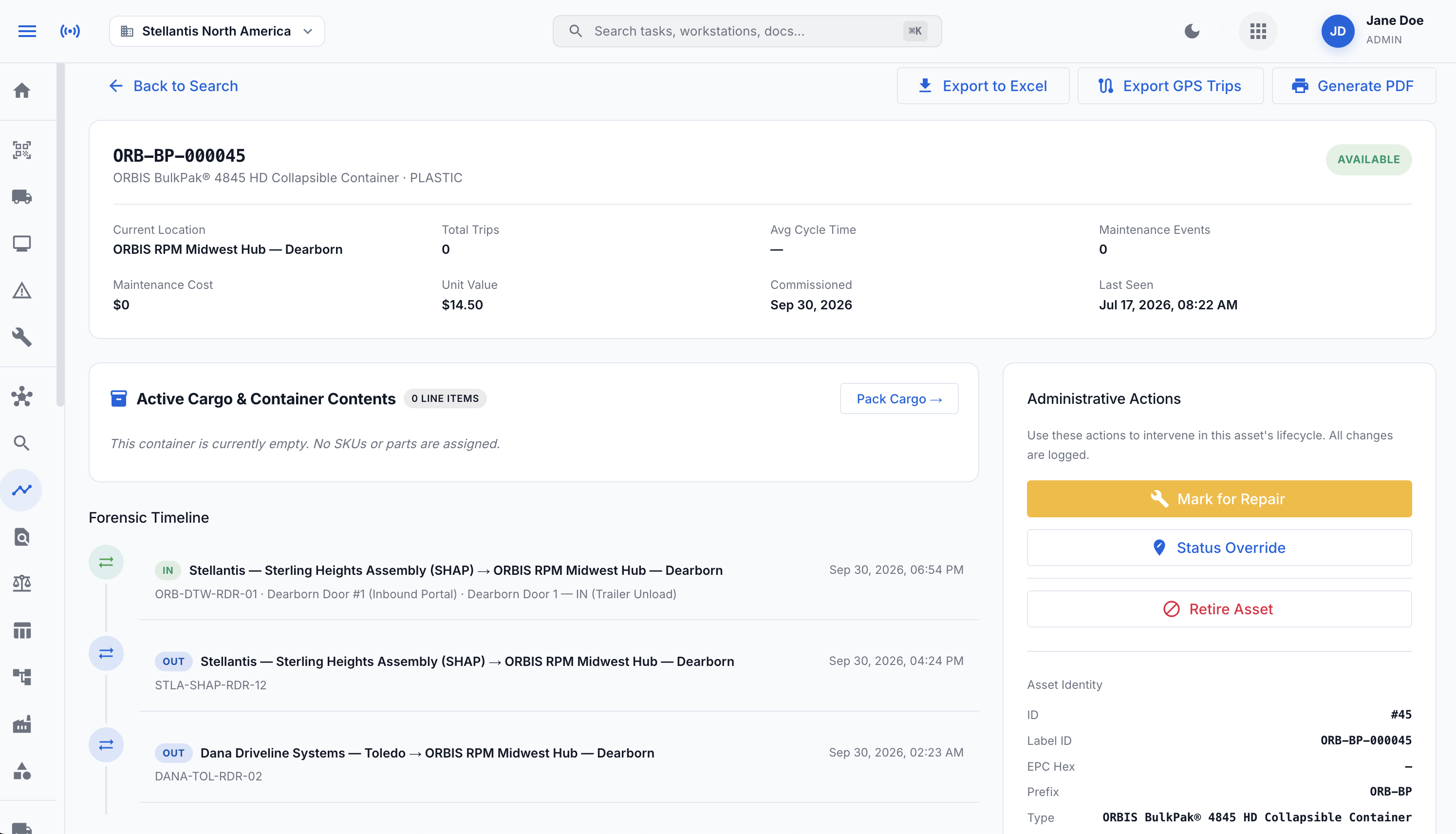
Already in force since the regulation's general application date — no separate phase-in. Operators running reusable packaging must participate in an organized reuse system and keep evidence of it: where the packaging went, how long it took to come back, and confirmation it was in a fit state to use again.
Article 27(2) is specific: packaging must be reconditioned — inspected, cleaned, repaired per Annex VI Part B — before every single reuse, not occasionally or on a sampling basis.
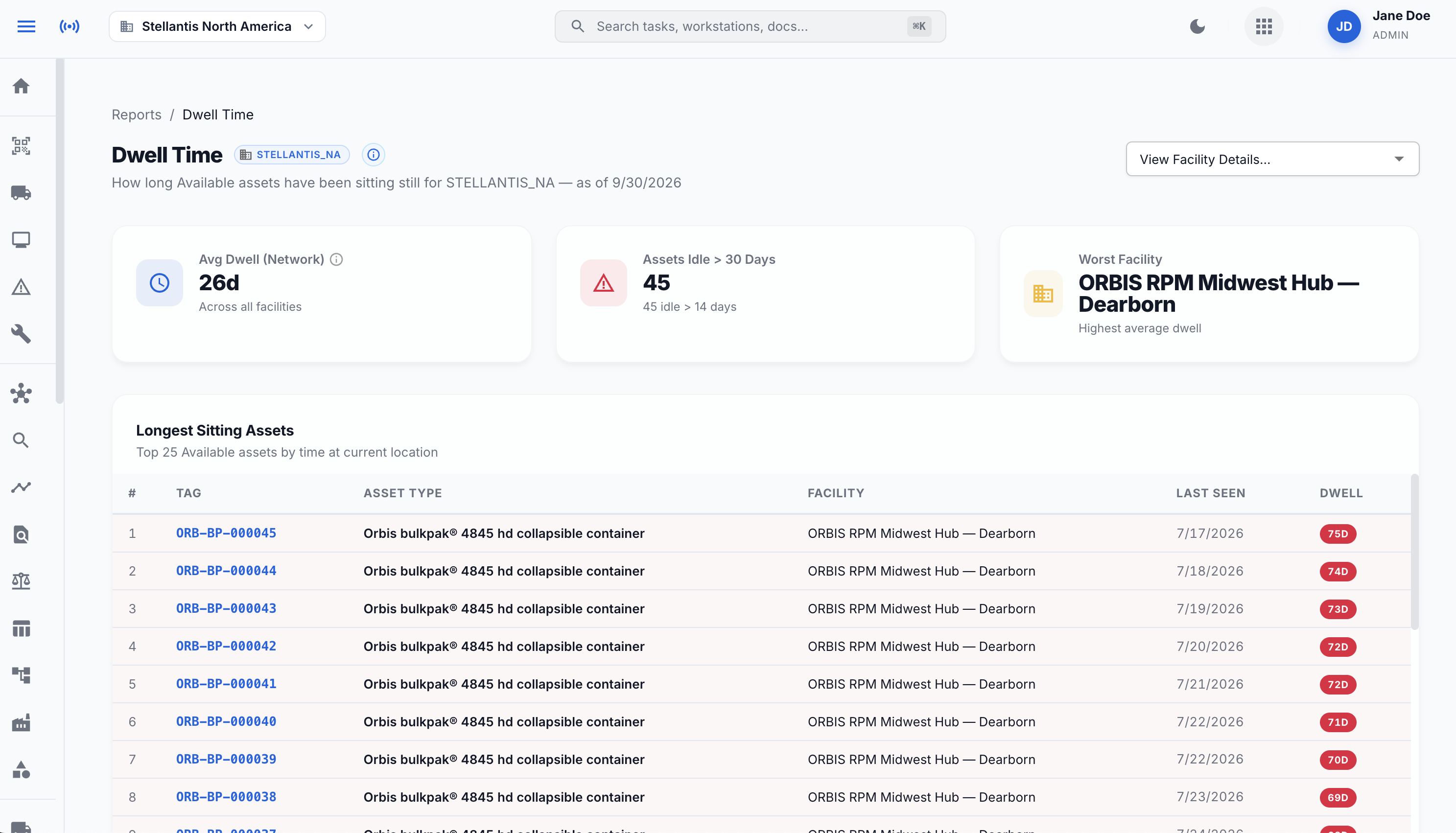
FlowTrace timestamps every reuse cycle end to end — origin, destination, cycle time, dwell time at each facility, and loss/shrinkage — which is close to the literal evidence trail Article 27 asks a reuse-system operator to keep.
Honest gap: we checked this directly against the code rather than assume it. The system already flags an asset Needs Inspection and raises an audit alert once it crosses a trip-count threshold — but that flag doesn't currently block the asset from shipping again, and maintenance records aren't linked to the specific trip that triggered it. Closing that loop — enforcing the flag, linking the record — is the real fix on our list, not a finished claim.
B2B Reusable Transport Packaging
By 2030, 40% of transport packaging — pallets, crates, boxes, trays, IBCs, drums — moving between businesses must be reusable, rising to 70% by 2040. A stricter rule applies to packaging moving between your own facilities, or to a linked enterprise anywhere in the EU: that has to be 100% reusable by 2030, no gradual ramp.
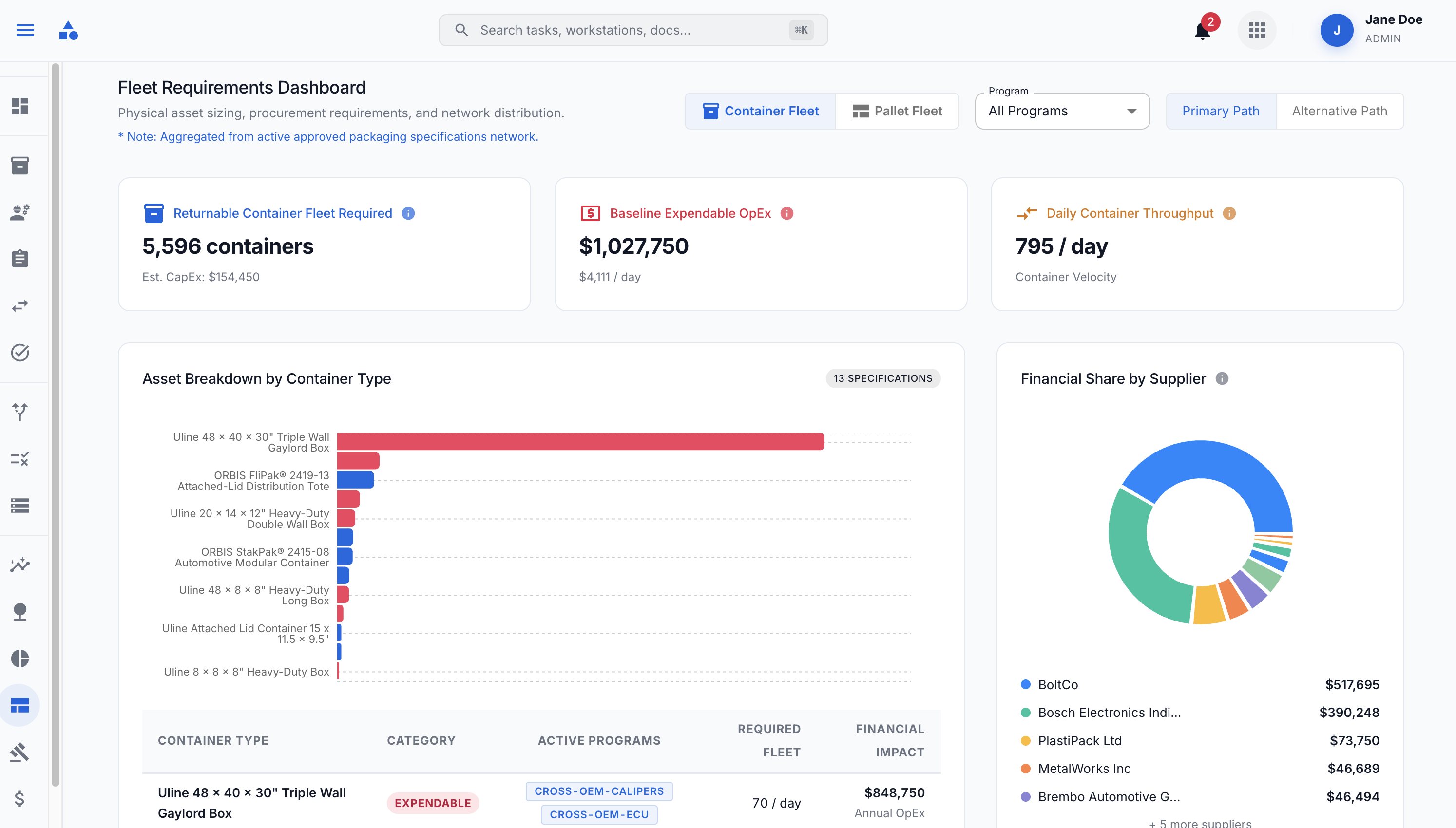
Every container and pallet spec already carries a returnable/expendable flag, and Fleet Requirements already splits forecasted demand by that same flag, per supplier.
Roadmap: plotting that existing split against the tiered 40% / 70% / 100% targets — and flagging which lanes count under the stricter intra-company rule — isn't built yet. The input data exists; the target-tracking view on top of it doesn't.
Recyclable by Design
Packaging must be "recyclable by design" starting 2030, and "recyclable at scale" — actually collected and recycled at real volume, not just theoretically possible — starting 2035. The European Commission grades packaging A/B/C against its own criteria. Grade C stays compliant until 2038; after that only A or B qualify.
Material composition is already captured on every packaging spec — the one input any future grading check would start from.
We're not building a pass/fail grader against this yet, and we're saying why plainly: the Commission hasn't published the A/B/C grading criteria. They're due by 2028. There's nothing to check against today even in principle — this is a regulatory gap, not a product one.
Packaging Minimization
From February 2028, all sales packaging must minimize empty space (no fixed percentage yet). From 2030, grouped/transport/e-commerce packaging is capped at a maximum 50% empty-space ratio — the air inside a single sealed unit relative to the product it actually holds.
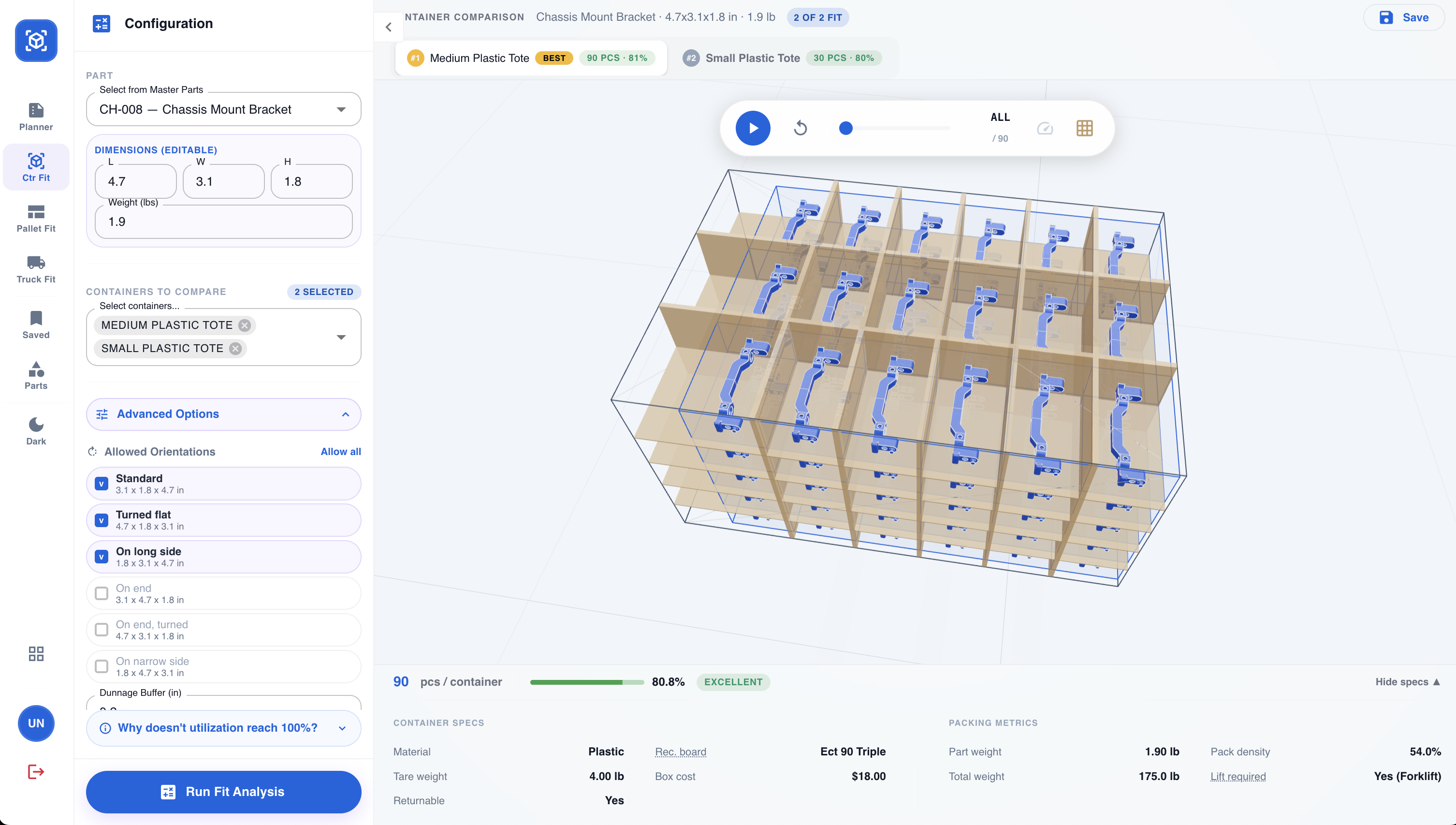
PackTetri's fit calculator already computes this number directly, not by proxy. Give it one part and one candidate container, and it runs a real geometric bin-packing solve — honoring orientation, rotation, and a configurable dunnage buffer for void fill — to find how many units physically fit, then reports the utilization percentage off that actual packed arrangement. Empty-space ratio is just the inverse of that number for a single sealed package, which is exactly the quantity Article 24 describes.
Honest gap: today it runs as an on-demand calculation per packaging setup, not an automatic pass/fail against the 50% threshold with the result stored as compliance evidence. Wiring the threshold check and persisting it per setup is next — the math itself is already real.
Harmonized Labeling / QR Data Carrier
From August 2028, consumer-facing primary packaging must carry a pictogram-based label showing material composition, to help the end consumer sort it correctly for recycling. Optionally, a QR code can carry the disposal destination for each separate component. Transport packaging is explicitly exempt from this obligation, with the exception of e-commerce packaging.
Our customer base today is industrial B2B — pallets and containers moving parts between automotive plants and distribution hubs. That's transport packaging, which this article exempts outright.
If that ever changes, the pattern to build this already exists, and not hypothetically: material composition, recycled content, and sorting/disposal instructions all live on the packaging master today, built the same way we built Article 7's recycled-content fields. The rendering layer — generating a printed or QR label from structured data — already exists too, in the form of FlowTrace's label-printing pipeline used for RFID asset tags.
Restricted Substances (PFAS)
Since August 12, 2026 — already current law — food-contact packaging cannot contain PFAS above set limits: 25 ppb for any single targeted substance, 250 ppb summed, or 50 ppm total fluorine.
This restriction is scoped specifically to food-contact packaging. Our packaging catalog — automotive totes, pallets, foam dunnage — isn't food-contact, so this doesn't apply to our business today.
If a future customer needed it, we wouldn't be starting from zero: the same pattern used to add Article 7's recycled-content fields to the packaging master — a new field plus an evidence/testing trail — is exactly how we'd add substances-of-concern tracking.
Oregon, Colorado, California & five more
Seven states — Oregon, Colorado, California, Minnesota, Maryland, Washington, and Maine — now require producers to register with a Producer Responsibility Organization (currently the Circular Action Alliance in most states) and file an annual material supply report, typically due around May 31.
Material Supply Report Live
A dedicated report aggregates packaging weight shipped by material category and month, drawn from the same packaging master and order data used across the platform. Formatting it against each state's specific material codes is next.
Eco-Modulated Fees Live
The same sustainability-grade engine used for PPWR recycled content already scores exactly what these fee schedules reward: recyclability, recycled content, and reuse.
Compliance that's a byproduct of the platform, not a bolt-on
The hard part of PPWR and State EPR reporting — an accurate material and weight picture per SKU, real evidence of reuse — is already a byproduct of running packaging engineering and asset tracking day to day. Where something isn't built yet, or doesn't apply to our customers today, we've said so above.
Talk to Us